Distributed Hydrogen Production Technology
Against the backdrop of the "dual carbon" goals, China is vigorously promoting the optimization and upgrading of its energy structure, with the development of the hydrogen energy industry becoming one of the main themes of energy development. Currently, issues regarding hydrogen supply guarantee and costs at hydrogen refueling stations in the transportation sector are becoming increasingly prominent, restricting the widespread adoption of hydrogen energy in daily life. This paper analyzes and discusses the industrial chain status and hydrogen supply prospects of various forms of distributed hydrogen production technologies, and demonstrates the positive significance of the integrated model combining hydrogen-based derivative conversion technology with distributed hydrogen production for China to accelerate the construction of a safe and stable hydrogen energy supply network.
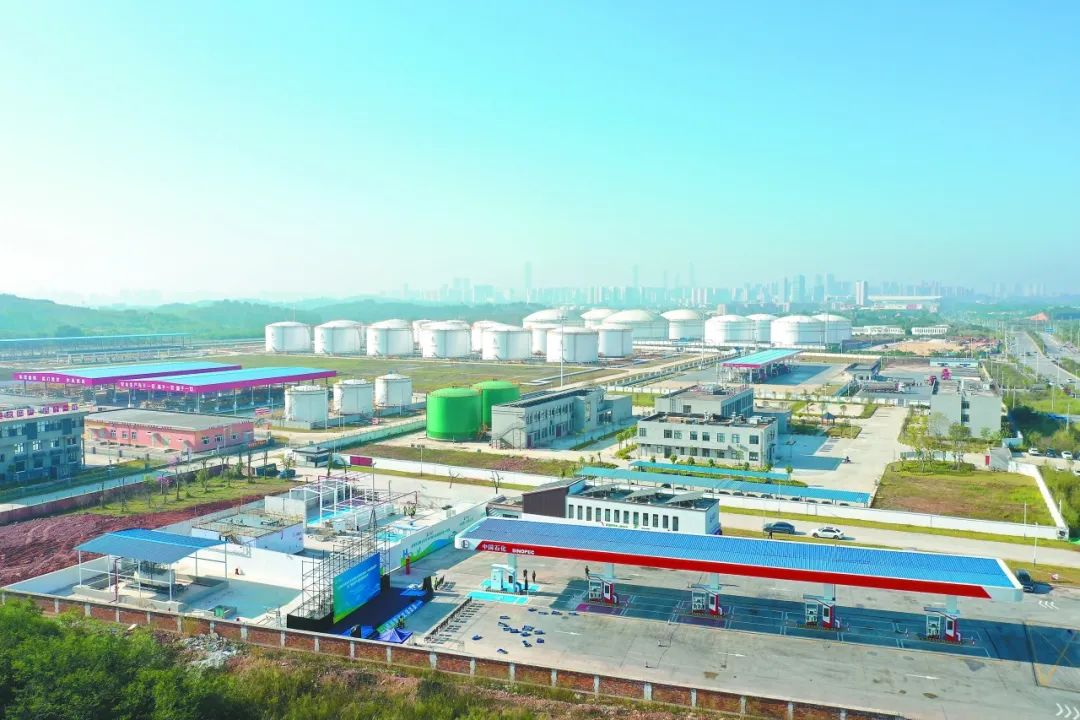
Hydrogen energy, as a key direction in the field of advanced energy technologies, has become one of the hotspots in international energy science, technology and industrial development. China attaches great importance to the development of the hydrogen energy industry. In 2022, the National Development and Reform Commission and the National Energy Administration jointly issued the Medium and Long-Term Plan for the Development of the Hydrogen Energy Industry (2021-2035), which clearly defines hydrogen's energy attribute as an integral part of the country's future energy system. It emphasizes giving full play to hydrogen energy's advantages of being clean and low-carbon, and promoting the green and low-carbon transformation of energy-consuming terminals such as transportation and industry, as well as high-energy-consuming and high-emission industries.Meanwhile, the plan identifies hydrogen energy as a key direction of strategic emerging industries, serving as a new growth point for building a green and low-carbon industrial system and driving industrial transformation and upgrading. Thanks to the clean, efficient and flexible characteristics of hydrogen fuel cells as end-use devices, hydrogen energy is gradually evolving into one of the important energy supply forms in modern society. Particularly in the process of transportation electrification, heavy-duty vehicles, ships and other means of transport face significant technical barriers to electrification, creating a demand for a new energy source to replace petroleum products. Hydrogen energy, as the anticipated secondary energy, produces no carbon dioxide emissions during use, and the generated water can re-enter the Earth's water cycle system.In recent years, numerous hydrogen refueling stations have emerged in cities, making hydrogen refueling for vehicles increasingly convenient. Data shows that by the end of 2023, China had built 428 hydrogen refueling stations, with 274 in operation. Among the over 1,000 hydrogen refueling stations built worldwide, China Petrochemical Corporation (Sinopec) has constructed 128. The hydrogen supplied by these stations mainly relies on long-tube trailer transportation, which poses safety risks, along with long loading and unloading times, low transportation efficiency, high costs and unsatisfactory comprehensive energy efficiency. These issues have made hydrogen supply guarantee and price problems at hydrogen refueling stations increasingly prominent, becoming a key bottleneck restricting the sustainable development of the entire hydrogen energy industry.
Analysis of the Current Situation of the Hydrogen Energy Market Supply Side
Therefore, the mode of distributed on-site hydrogen production and supply has attracted growing attention. The research team from Sinopec Research Institute of Petroleum Processing has conducted an in-depth analysis of the limitations and major contradictions of existing hydrogen supply methods in the market, explored the development status of distributed hydrogen production technology from R&D to application, envisioned its economic advantages and development prospects, and put forward suggestions for the development of distributed hydrogen production technology in China.
Distributed Hydrogen production technology
Traditional hydrogen production technologies include coal-based hydrogen production, petroleum-based hydrogen production, natural gas-based hydrogen production, alcohol-based hydrogen production, water electrolysis for hydrogen production, etc. Since distributed hydrogen production needs to meet the requirements of easily available raw materials, integrable equipment, and low pollutant discharge, natural gas-based hydrogen production, methanol-based hydrogen production, ammonia decomposition for hydrogen production, and water electrolysis for hydrogen production have become preferred routes.
Looking at the current situation of green and low-carbon energy development in China, green natural gas, green methanol, green ammonia, and green electricity are all green energy carriers, which are also in line with China's original intention of developing hydrogen energy.
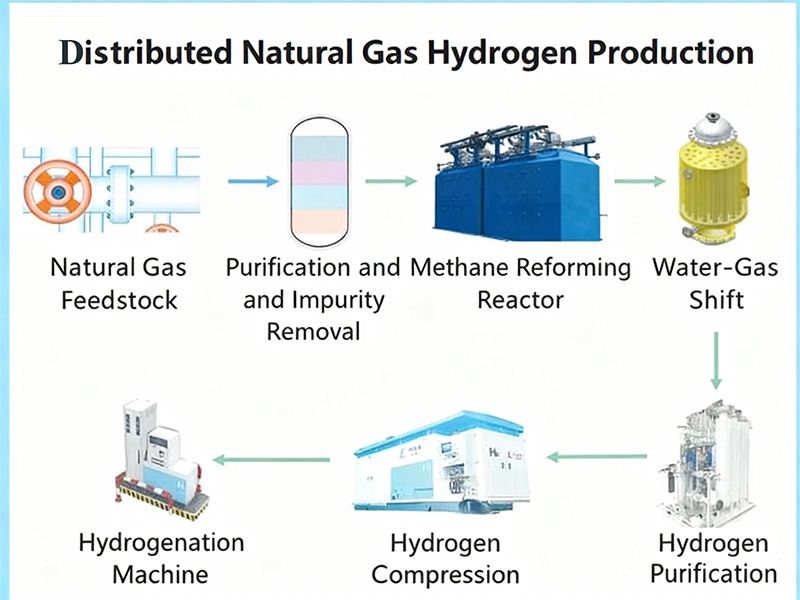
Natural gas can be conveniently used to produce hydrogen, and this technology is widely applied in many petrochemical enterprises. Additionally, cities have well-developed natural gas pipeline networks, which lay the foundation for realizing distributed natural gas-based hydrogen production at hydrogen refueling stations.Distributed natural gas-based hydrogen production uses natural gas as raw material to generate hydrogen through a series of chemical reactions, including natural gas purification, reforming reaction, water-gas shift reaction, and hydrogen purification. Among these processes, natural gas reforming reaction needs to be completed at 850°C, so the miniaturization and intelligentization of the reforming reactor is one of the core aspects of the entire technology. Moreover, high-performance reforming catalysts and shift catalysts must meet the new requirements of high integration for distributed hydrogen production.Unlike factories that have complete utility conditions and spacious sites, distributed hydrogen production requires extensive process intensification and process optimization technologies to reduce floor space and improve hydrogen production efficiency. A typical domestic demonstration case is the Nanhai 南庄 Hydrogen Production and Refueling Integrated Station in Foshan, Guangdong, which adopts distributed natural gas-based hydrogen production technology, including equipment such as small-scale reforming furnaces.
Distributed Methanol-Based Hydrogen Production
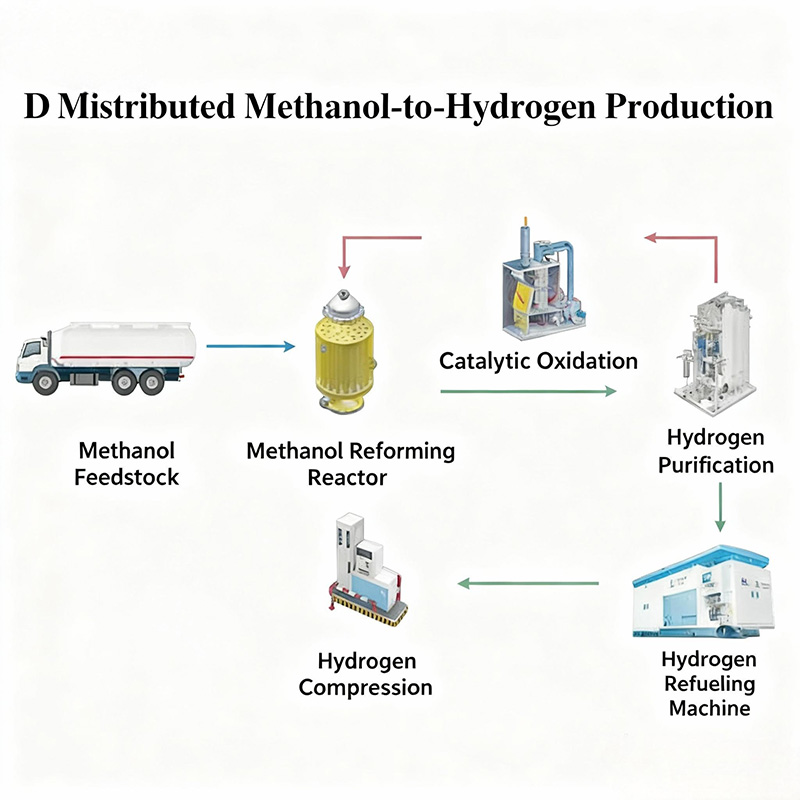
Methanol-based hydrogen production is one of the widely used hydrogen production technologies in the chemical industry. Methanol, as a bulk chemical raw material, features abundant sources and low cost. It exists as a liquid under normal temperature and pressure, making it easy to store and transport. China accounts for 60% of the global methanol production capacity, thus providing highly favorable conditions for methanol-based hydrogen production. In particular, the massive launch of domestic green methanol projects has offered support for hydrogen refueling stations to produce green hydrogen using green methanol.Methanol-based hydrogen production is a process that generates hydrogen from methanol and water as raw materials under the action of catalysts. Industrial methanol-based hydrogen production mostly adopts combustion furnace heating, with a relatively simple process. However, such an open-flame heating mode is not feasible in hydrogen refueling stations where land is extremely valuable. Therefore, distributed methanol-based hydrogen production mainly employs the "methanol reforming + catalytic oxidation" method. The process of methanol-based hydrogen production mainly includes methanol reforming, catalytic oxidation, and hydrogen purification.Methanol-based hydrogen production operates under mild conditions: the temperature inside the hydrogen production system can reach approximately 250°C, and the product hydrogen pressure ranges from 1.5 to 2.5 MPa. The use of catalytic oxidation for energy supply not only solves the problem of desorbed gas emission but also ensures the intrinsic safety of the system's energy supply. Hence, methanol reforming catalysts, catalytic oxidation catalysts, and system integration technologies are the core technologies of distributed methanol-based hydrogen production.
A typical domestic demonstration case is the Shenggang Comprehensive Energy Station in Dalian, Liaoning, which is China's first commercially operated integrated hydrogen production and refueling station. Adopting Sinopec's proprietary technology, it can produce 1,000 kg of high-purity hydrogen meeting fuel cell hydrogen standards per day.
Distributed Ammonia Decomposition for Hydrogen Production
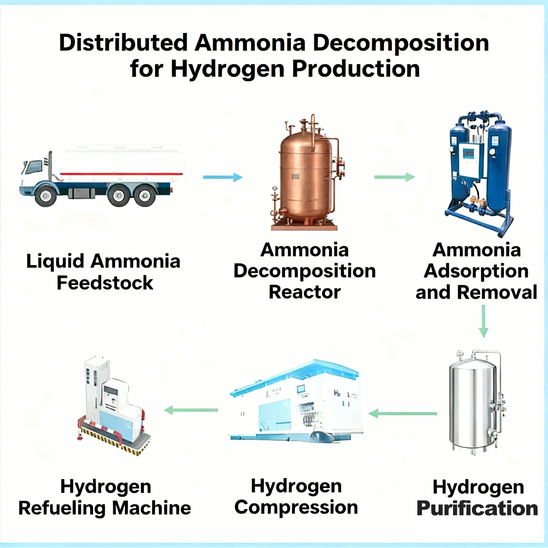
Distributed Ammonia decomposition for distributed hydrogen production is a process that generates hydrogen and nitrogen using liquid ammonia as the feedstock. This technology offers the advantage of zero carbon emissions at the user end. The combination of renewable hydrogen and nitrogen renders ammonia a hydrogen energy carrier with zero carbon emissions, and its hydrogen production energy consumption is only one-third of that of water electrolysis for hydrogen production. Thus, it is regarded as a new approach to addressing the challenges of hydrogen transportation and storage.Distributed ammonia decomposition for hydrogen production mainly comprises an ammonia decomposition furnace and two-stage hydrogen purification. By developing high-efficiency, low-temperature, and long-life ammonia decomposition catalysts, as well as high-performance hydrogen-nitrogen separation technologies, the energy consumption for hydrogen production can be significantly reduced.
A typical domestic demonstration case is the Sinopec Nanning Zhenxing Hydrogen Production and Refueling Integrated Station in Guangxi. Employing Sinopec's proprietary technology, it can produce 500 kg of 99.999% high-purity hydrogen per day, which can meet the hydrogen demand of over 40 hydrogen fuel cell vehicles.
Distributed Water Electrolysis for Hydrogen Production
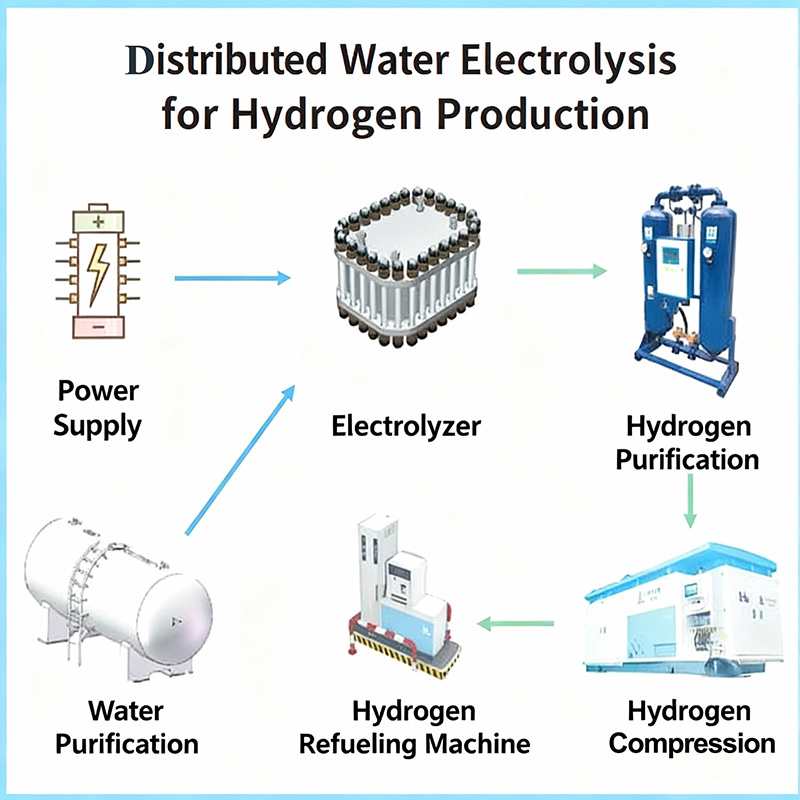
Water electrolysis for hydrogen production has long been used in small-scale hydrogen production scenarios. Thanks to the extensive and rapid development of low-carbon energy in China, water electrolysis for hydrogen production has entered a boom period. According to the type of electrolyte used, water electrolysis methods are divided into alkaline water electrolysis (ALK), proton exchange membrane electrolysis (PEM), solid oxide electrolysis (SOEC), and alkaline anion exchange membrane electrolysis (AEM), among which SOEC and AEM are currently in the exploratory stage. Alkaline water electrolysis and proton exchange membrane water electrolysis are the main methods for distributed water electrolysis for hydrogen production. The cost of electricity consumption accounts for 75% to 85% of the total cost of water electrolysis for hydrogen production, and the system mainly includes power supply, electrolyzer, and hydrogen purification units. Compared with alkaline water electrolysis for hydrogen production, proton exchange membrane water electrolysis has lower energy consumption, a more compact equipment structure, and flexible start-up and shutdown, making it more suitable for off-grid hydrogen production, but the current investment is relatively high.
Outlook for Distributed Hydrogen Production Technology
With the rapid development of China's hydrogen energy industry, the demand for hydrogen has increased significantly. The contradictions between hydrogen production, storage, transportation, and utilization have become increasingly prominent, creating an urgent need for new hydrogen supply models.
Adopting distributed on-site hydrogen production at hydrogen refueling stations can address issues such as excessively high hydrogen storage and transportation costs and insufficient infrastructure, making it one of the short-to-medium-term hydrogen source solutions. Foreign countries have launched demonstrations of various technical forms—for example, France's Houdain Hydrogen Refueling Station, Japan's Okawa Hydrogen Refueling Station, and the United States' Santa Monica Hydrogen Refueling Station all adopt on-site hydrogen production to supply hydrogen, ensuring a flexible and reliable hydrogen supply network.
Domestically, the development of distributed hydrogen production technology has been relatively slow due to factors such as technical specifications and approval processes. However, as Guangdong Foshan, Sichuan Chengdu, Liaoning Dalian, Shandong Zibo, Hubei Wuhan, Inner Mongolia Ordos, and other regions have successively introduced corresponding policies to support distributed hydrogen production projects, domestic technological development and market demand have ushered in new opportunities.
The choice of hydrogen production route mainly depends on the accessibility and cost of raw materials. In the future, the combination of distributed hydrogen carrier-based hydrogen production and fuel cells is likely to gain broader market opportunities in hydrogen energy application fields such as uninterruptible power supplies, household combined heat and power systems, and distributed power stations.
Typical Cases
Nanhai Zhuang Hydrogen Production and Refueling Integrated Station in Foshan, Guangdong
As an integrated energy supply station integrating natural gas-based hydrogen production, photovoltaic power - coupled water electrolysis for hydrogen production, hydrogen refueling, gas refueling and charging, it serves as a parent station for on-site hydrogen production and refueling. It has taken the lead in adopting skid-mounted natural gas hydrogen production equipment, capable of producing hydrogen with a purity of 99.999%. The station boasts a natural gas hydrogen production capacity of 500 standard cubic meters per hour and a water electrolysis hydrogen production capacity of 50 standard cubic meters per hour. Its daily hydrogen production and refueling capacity reaches 1,100 kilograms, which can meet the hydrogen demand of 100 bus trips or 150 logistics vehicle trips.
Shengang Comprehensive Energy Station in Dalian, Liaoning
As a key demonstration project for distributed methanol-to-hydrogen production in China, this station can generate 1,000 kilograms of high-purity hydrogen with a purity of 99.999% per day. It adopts a distributed methanol-to-hydrogen system independently developed by Sinopec, incorporating a number of independent innovation achievements such as methanol reforming, catalytic oxidation, process intensification and system integration. On the premise of meeting the safety and operation control requirements of hydrogen refueling stations, the methanol consumption for each standard cubic meter of fuel cell - grade hydrogen can be as low as 0.67 kilograms. Compared with similar domestic operating devices, it features lower energy consumption, less methanol consumption and more remarkable economic benefits.
Zhenxing Hydrogen Production and Refueling Integrated Station in Nanning, Guangxi
This station adopts an integrated whole-industry-chain model covering hydrogen production, storage, refueling and transportation. Liquid ammonia delivered to the station is unloaded into ammonia storage tanks and then transported to the hydrogen production module. Through the independently developed integrated process of ammonia decomposition and hydrogen purification, ammonia is decomposed into hydrogen and nitrogen. After compression, separation and purification, hydrogen is produced from the hydrogen production module, which can either be transported to surrounding stations by tube trailers or directly refueled into vehicles. The station is equipped with intelligent control functions including real-time information collection, cloud monitoring and automatic alarm. The hydrogen production equipment covers an area of only 80 square meters and can produce 500 kilograms of high-purity hydrogen with a purity of 99.999% per day, currently meeting the demand for vehicle-used hydrogen in cities such as Nanning, Liuzhou and Beihai.
Article Source:Lanbai Pilot Zone Joint Innovation Research Institute
Disclaimer:The information reprinted on this website comes from cooperative media, institutions or other websites. It is published for the purpose of conveying more information and does not imply approval of its views or confirmation of the authenticity of its content. All information on this website is for reference only and shall not be used as the basis for transactions or services. If there is any infringement or other issues with the content of this website, please inform us promptly, and we will modify or delete it in a timely manner. Anyone who logs on to this website or uses the data of this website directly or indirectly in any way is deemed to voluntarily accept the constraints of this website statement.