

Development History
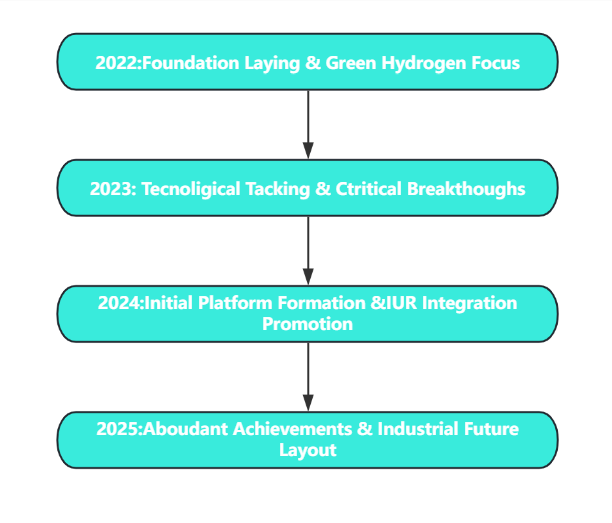
2022: Foundation and Take-off, Focus on Green Hydrogen: The research institute was officially established in 2022. Rooted in the context of China’s "dual carbon" strategy, it focuses on the R&D of new green hydrogen production materials and core technologies. At its inception, the institute clearly defined its mission to drive cost reduction and efficiency improvement in the hydrogen energy industry through technological innovation, with key layouts in the field of critical materials for water electrolysis hydrogen production. It specifically targets cutting-edge directions such as high-activity catalysts and low-cost membranes required for proton exchange membrane (PEM) electrolyzers and anion exchange membrane (AEM) electrolyzers.Led by Academician Yu Jiaguo of the European Academy of Sciences, the institute’s R&D team brings together experts in materials science and electrochemistry from renowned universities and enterprises at home and abroad. It has initially built an advanced platform for material synthesis, membrane electrode preparation and electrochemical testing. By establishing preliminary cooperation with leading domestic hydrogen energy enterprises, the institute achieved a breakthrough from zero to one in its first year of establishment, laying a solid organizational foundation, technical foundation and cooperative network for subsequent technological breakthroughs and industrial applications.
2023: Technological Tackling, Achieving Critical Breakthroughs: In 2023, the research institute entered an intensive period of technological tackling. Building on previous R&D accumulation, it made a series of important progress in the field of low-cost, high-performance hydrogen production materials.In terms of catalysts, the team successfully developed a new type of core-shell structured low-platinum catalyst. Its mass activity has increased by more than 50% compared with commercial catalysts, and the cost has been effectively controlled through innovative synthesis processes. Meanwhile, in the R&D of non-precious metal catalysts, catalyst samples based on transition metal phosphides and nitrides have demonstrated activity close to that of precious metals and excellent stability in tests, bringing hope for complete "platinum-free" technology. The institute successfully applied for 10 core invention patents and built the first kilogram-scale pilot production line for catalysts. This marks a key step forward in transforming R&D work from laboratory samples to engineering products. These breakthroughs have not only enhanced the team’s technical confidence but also attracted the attention and cooperation intentions of more industrial chain partners.
2024: Platform built, Promoting Industry-University-Research Integration:2024 was a year when the research institute advanced in depth from technological R&D to platform construction and achievement transformation. Its core task was to push the breakthrough technologies from the laboratory to pilot verification and initial industrial application. It has built a small-scale integrated testing platform covering "materials - membrane electrodes - electrolyzers", which can provide customized material verification and solutions for customers and partners.The institute actively integrated into the regional hydrogen energy industrial ecosystem, took the lead in establishing the "Advanced Hydrogen Production Materials Innovation Consortium", and jointly applied for and undertook a provincial-level major science and technology special project in collaboration with upstream and downstream enterprises and universities. In terms of team building, the institute introduced experts in industrialization and project management, forming a complete talent system covering basic research, engineering scale-up, testing and evaluation, and market application. Its innovation vitality and comprehensive strength have been significantly enhanced.
2025:Emerging Achievements and Layout for Industrial Future: By 2025, the research institute has developed into a new-type R&D institution with significant influence in the field of new hydrogen production materials, with technological innovation and industrialization achievements emerging one after another. Its product line has expanded from a single catalyst to a variety of key materials including special anion exchange membranes and porous transport layers, initially forming the capability to provide integrated material solutions. The institute has launched forward-looking research on materials for next-generation hydrogen production technologies such as high-temperature solid oxide electrolysis (SOEC). It plans to build an energy new materials certification and testing center within the next three years, striving to become a core material source and driving engine leading the development of China’s green hydrogen industry.