Analysis and Economic Evaluation of Green Power-to-Hydrogen Technology Routes
As a key development direction of China's hydrogen energy industry, green power-to-hydrogen not only meets the country's requirements for "clean and low-carbon" hydrogen energy industry, but also leverages hydrogen's significant advantages in large-scale energy storage and flexible power regulation, thereby promoting the development of new energy. However, since green power-to-hydrogen in China is still in the "pioneering and pilot" stage, some demonstration projects are scattered across the country, with different technical routes yet to be fully mature and economies of scale yet to be realized.
In-depth analysis and evaluation of different green power-to-hydrogen routes, and identifying development directions based on local conditions, are crucial for China to centrally break through technical bottlenecks in the hydrogen energy industry. This paper analyzes the characteristics of different technical routes for green power-to-hydrogen, and conducts economic analysis on green power-to-hydrogen projects in regions rich in wind power and photovoltaic resources in China. It aims to provide suggestions and references for the rapid development and large-scale industrial implementation of China's green power-to-hydrogen industry.
1 Basic Hydrogen Production Technology Routes
1.1 PEM Hydrogen Production
PEM is the abbreviation of Proton Exchange Membrane water electrolysis technology. Unlike traditional alkaline water electrolysis for hydrogen production, PEM electrolysis technology uses a proton exchange membrane as the solid electrolyte and employs pure water as the raw material for electrolysis, thus avoiding potential alkali liquor pollution and corrosion issues. PEM hydrogen production technology boasts advantages such as high purity of produced hydrogen, high output hydrogen pressure, high operating current density, wide load range, and fast dynamic response speed.
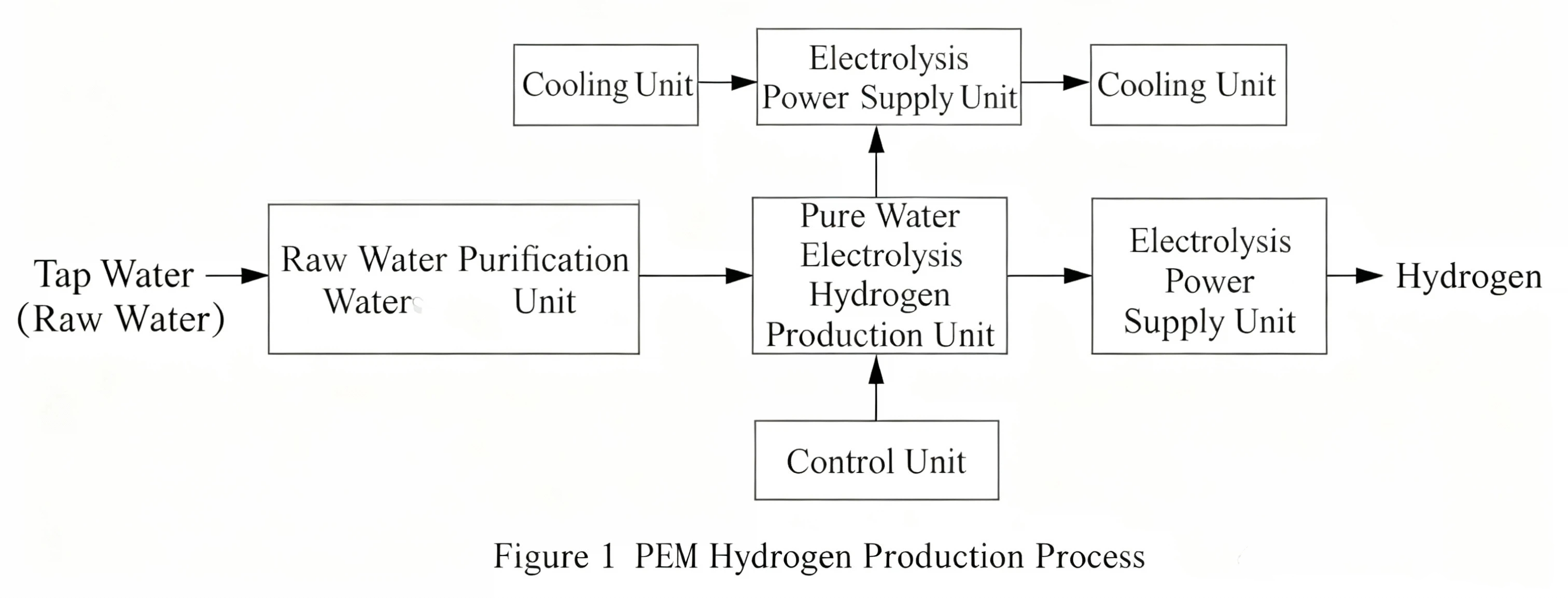
The PEM hydrogen production system mainly consists of a pure water electrolysis unit, electrolysis power supply unit, cooling unit, control unit, hydrogen storage tank, and hydrogen storage system, as shown in Figure 1.
1.2 Alkaline Water Electrolysis for Hydrogen Production
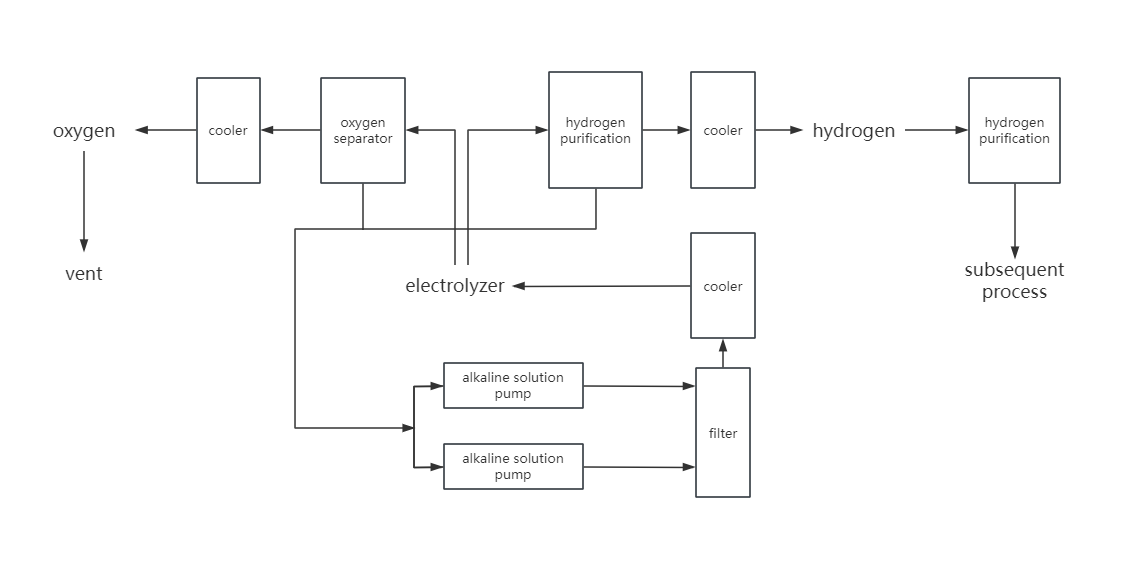
High-purity hydrogen is obtained by electrolyzing pure water. However, due to the poor electrical conductivity of pure water, an alkaline electrolyte solution needs to be added, hence the name "alkaline water electrolysis for hydrogen production"—currently one of the most widely applied hydrogen production methods. When direct current is passed into an electrolyzer containing an alkaline aqueous solution (such as KOH), water is electrolyzed into hydrogen and oxygen. The process flow is shown in Figure 2.
1.3 AEM Hydrogen Production Equipment
Anion Exchange Membrane (AEM) water electrolysis for hydrogen production is a technology that uses an anion exchange membrane as the electrolyte, pure water or low-concentration alkaline solution as the electrolyte, and transition metal catalysts as the anode and cathode catalysts. Its working principle is similar to that of other water electrolysis technologies, involving two half-reactions: oxygen evolution reaction and hydrogen evolution reaction.In an AEM electrolyzer, water or low-concentration alkaline solution enters from the anode and diffuses through the AEM membrane to the cathode. Driven by a voltage of 1.8–2.5V, the hydrogen evolution reaction occurs electrochemically at the cathode, decomposing water to produce H₂ and OH⁻. Under the action of concentration and voltage gradients, OH⁻ diffuses to the anode where the oxygen evolution reaction takes place, releasing oxygen.
1.4 SOEC Hydrogen Production Equipment
Solid Oxide Electrolysis Cell (SOEC) operates on the principle of electrolyzing water molecules into hydrogen and oxygen at high temperatures (typically 600–900°C) by utilizing the ionic conductivity of solid oxide electrolytes. An SOEC mainly consists of an electrolyte, a fuel electrode, an oxygen electrode, as well as corresponding supports, connectors, and sealing materials.
The fuel electrode and oxygen electrode are generally made of cermet materials with a porous structure, which facilitates good gas flow. The electrolyte layer is usually an oxygen ion or proton-conducting material with a dense structure, which can separate gases at the anode and cathode while conducting ions.
2. Comparison of Basic Hydrogen Production Technology Routes
A comparison of the four main water electrolysis hydrogen production technology schemes is shown in Table 1.
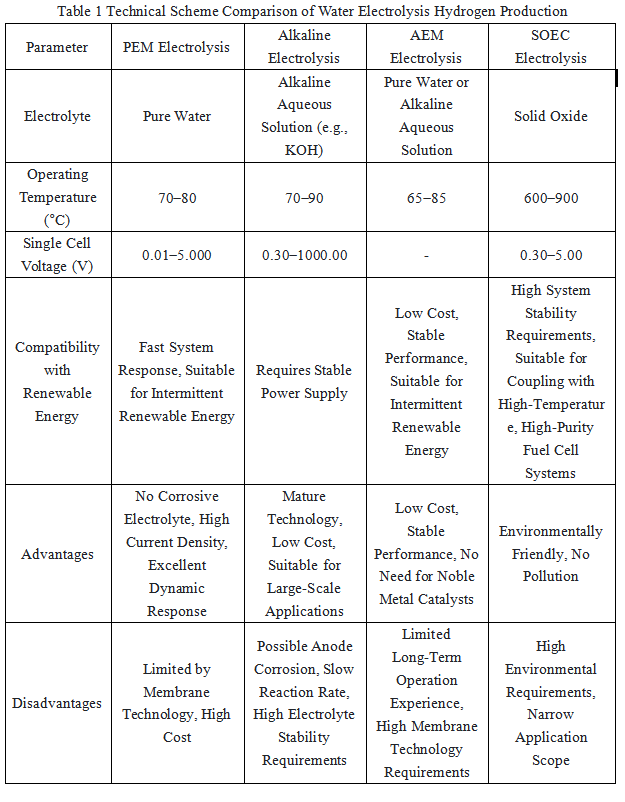
As can be seen from the above table, due to the overall immature technology, insufficient hydrogen production capacity, and relatively harsh environmental requirements of AEM and SOEC hydrogen production, their application is limited. In contrast, PEM hydrogen production and alkaline water electrolysis are relatively mature technologies.PEM hydrogen production can adapt to the volatility of new energy and is environmentally friendly, but it has high costs and slightly lower output. Alkaline water electrolysis, on the other hand, offers large output and low costs, yet it carries potential pollution risks and requires stable power supply.PEM hydrogen production and alkaline water electrolysis are highly complementary in terms of overall technology. In certain hydrogen production scenarios, the two technologies are used in combination.
3. Economic Analysis of Green Power-to-Hydrogen
3.1 Economic Analysis of Large-Scale New Energy Hydrogen Production Project Cases
Referring to the Notice on Accelerating the Coordinated Development of New Energy and Related Industries (Xin Fa Gai Gui [2023] No. 2) issued by the Xinjiang Uygur Autonomous Region, a hydrogen production project with an annual output of 10,000 MWh requires a 150,000 kW photovoltaic (PV) system or wind power with equivalent electricity output (approximately 90,000 kW), along with grid-connected power generation of the same scale. Economic analysis and calculations are conducted separately for wind power-to-hydrogen and PV power-to-hydrogen scenarios.
Basic Case Information
A hydrogen production facility with an annual output of 10,000 tons is constructed, adopting a wind power generation and surplus power grid-connection operation mode. The hydrogen production equipment utilizes alkaline water electrolysis technology. The tables of calculated boundary condition values and investment estimation indicators are shown in Table 2.
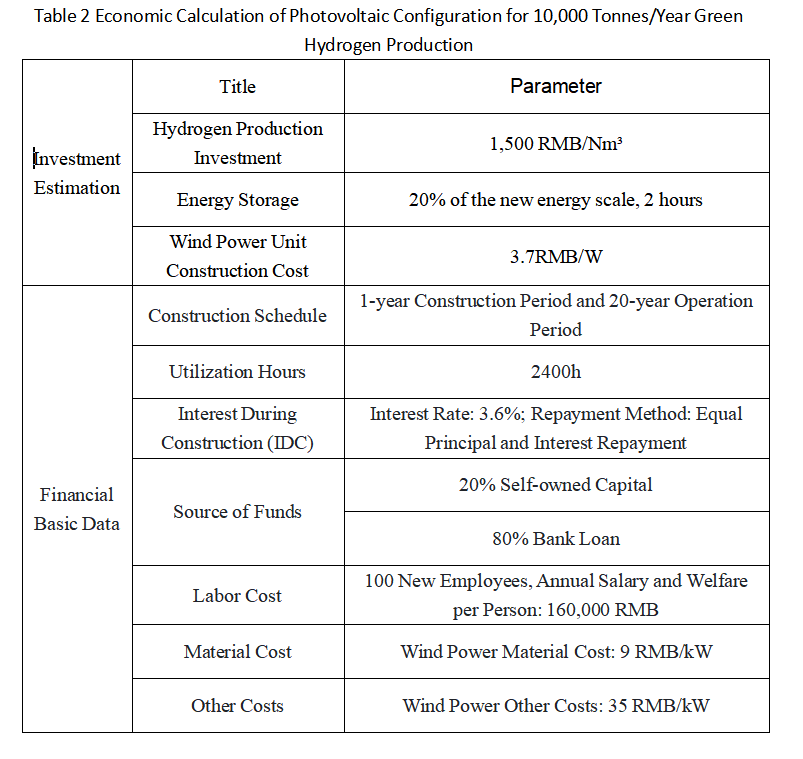
Based on the data in the above table, the following calculations are made respectively:① When the hydrogen production cost is 20 yuan/kg and the on-grid electricity price is 0.262 yuan/kWh, to ensure the project is profitable, it is inferred that a 300MW wind power plant needs to be built to meet the requirement of an 8% internal rate of return on project capital for normal operation.② In accordance with the requirements of the regional document, taking the construction of a 10,000 t/a hydrogen production project with a supporting new energy wind power installation capacity of 90,000 kW as an example, under the same conditions, it is inferred that when the hydrogen price reaches 33.5 yuan/kg, the project can meet the economic feasibility of achieving an 8% internal rate of return on project capital.
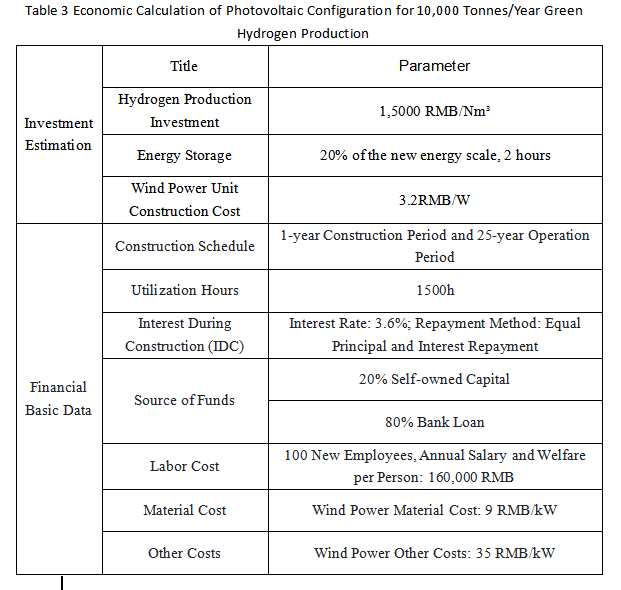
Basic Case Information:A 10,000 t/a water electrolysis hydrogen production project is constructed, adopting a photovoltaic power generation and surplus power grid-connection operation mode. The hydrogen production equipment utilizes alkaline water electrolysis technology. The tables of calculated boundary condition values and investment estimation indicators are shown in Table 3.Based on the data in the above table, the following calculations are made respectively:① When the hydrogen production cost is 18 yuan/kg and the on-grid electricity price is 0.262 yuan/kWh, to ensure the project is profitable, it is inferred that a 300MW photovoltaic power plant needs to be built to meet the requirement of an 8% internal rate of return on project capital for normal operation.② In accordance with the requirements of the regional document, taking the construction of a 10,000 t/a hydrogen production project with a supporting new energy photovoltaic installation capacity of 150,000 kW as an example, under the same conditions, it is inferred that when the hydrogen price reaches 35 yuan/kg, the project can meet the economic feasibility of achieving an 8% internal rate of return on project capital.
3.2 Comparison Between Green Power-to-Hydrogen Price and Traditional Chemical Hydrogen Production Price
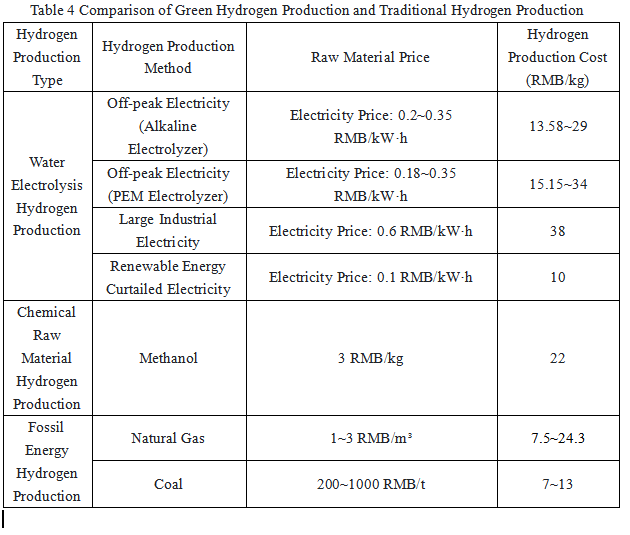
Compared with traditional chemical hydrogen production, the electricity price has a significant impact on the hydrogen production cost. A comparison table between green power-to-hydrogen and traditional hydrogen production is shown in Table 4.
3.3 Influencing Factors of Green Power-to-Hydrogen Product Price
Taking the construction of a 10,000 t/a water electrolysis hydrogen production project with a supporting total new energy installation capacity of 90,000 kW wind power as an example, a single-factor sensitivity analysis is conducted on key uncertain factors that have a significant impact on project benefits, including product price, output, electricity consumption, and construction investment, to determine the key influencing factors. The analysis diagram of influencing factors for green power-to-hydrogen is shown in Figure 3.
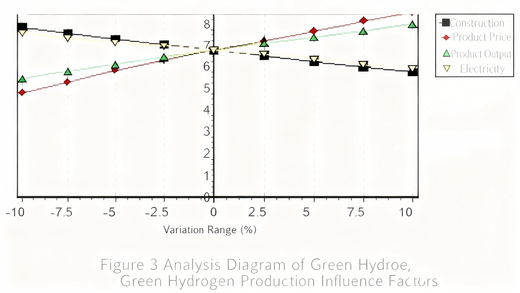
As can be seen from the data in Figure 3, the product price (electricity price) is highly sensitive to the project's economic benefits, followed by product output and electricity consumption. Therefore, fluctuations in product price and output will have a significant impact on the project.
4. Conclusion
From the analysis in this paper, among the four common water electrolysis hydrogen production methods—PEM hydrogen production, alkaline water electrolysis, AEM hydrogen production equipment, and SOEC hydrogen production equipment—PEM hydrogen production and alkaline water electrolysis are relatively mature and have achieved large-scale application.The future development trend is that the advantages of PEM water electrolysis and alkaline water electrolysis will complement each other for combined use. Compared with traditional chemical hydrogen production, the cost of green power-to-hydrogen is still relatively high. However, with the continuous expansion of new energy power generation scale and the decline in electricity prices, there is significant room for reducing the cost of green power-to-hydrogen.
At present, to ensure the sustainability of green power-to-hydrogen, it is recommended to expand the scale of supporting new energy for green power-to-hydrogen projects, which can either be integrated into the power grid for consumption or provided with certain price subsidies.
Article Source: Carbon Neutrality and Sustainable Development
Disclaimer:The information reprinted on this website is sourced from cooperative media, institutions, or other websites. Such publication is intended solely for the purpose of disseminating more information and does not imply endorsement of the views contained therein or verification of the authenticity of the content. All information on this website is for reference only and shall not serve as the basis for any transactions or services.
Should any content on this website involve infringement or other issues, please notify us promptly, and we will make corrections or remove the relevant content in a timely manner. Anyone who accesses this website by any means or uses the materials on this website directly or indirectly shall be deemed to have voluntarily accepted the constraints of this disclaimer.